When a position opens, managers often ask themselves: should we look for an employee on our own or turn to a recruitment agency?
There is no single answer. Both approaches have their advantages, and the choice depends on business goals, the complexity of the vacancy, the timeline and the company's internal resources.
It is important to understand that this is not a competition between in-house HR and an agency. Ideally they become partners working towards a common goal – finding a strong specialist.
Let's look at when each option works best.
When an in-house recruiter is enough
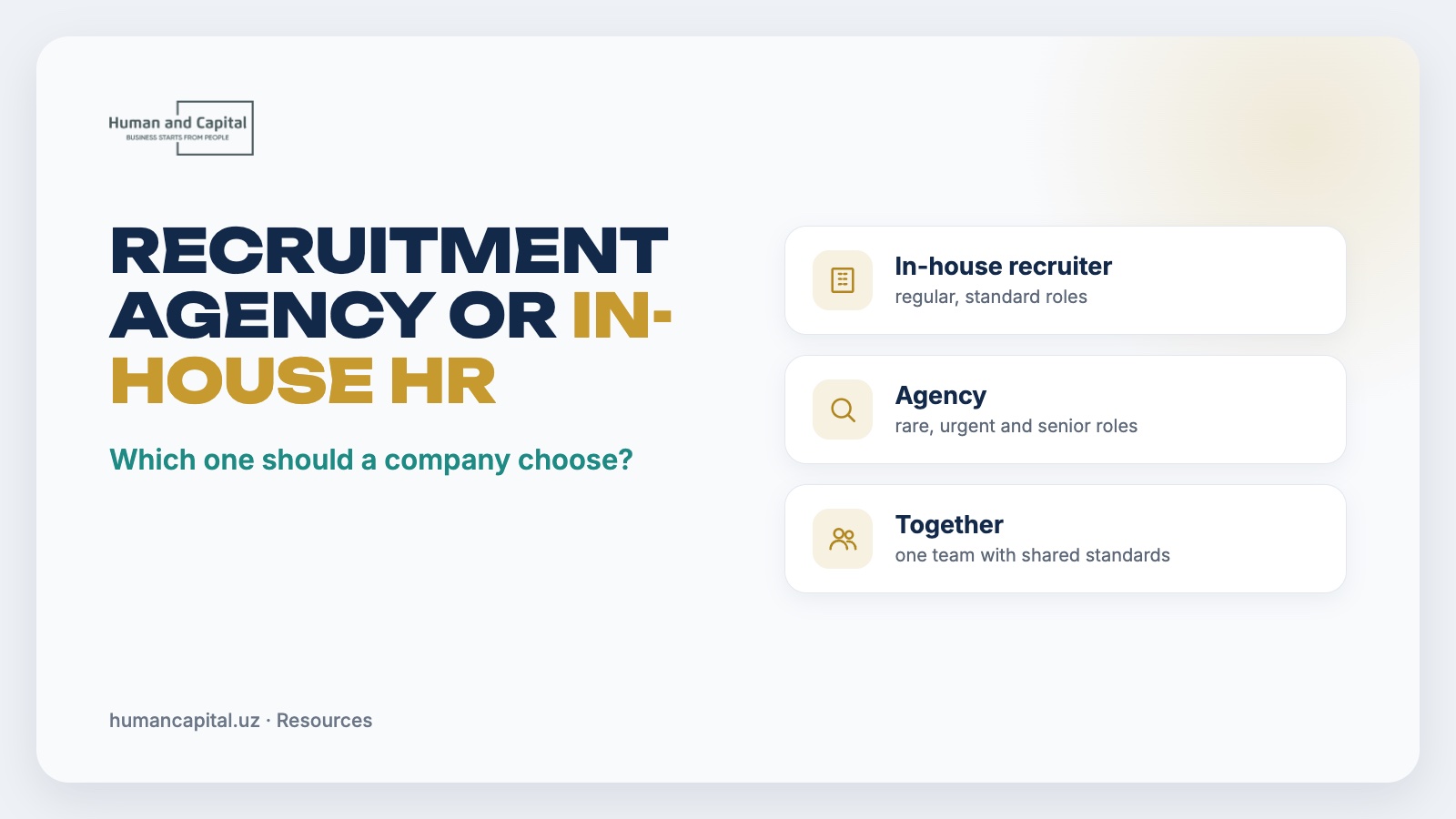
If the company already has an established HR function, most vacancies are filled successfully in-house.
Especially if:
- standard positions open regularly;
- the company has a strong employer brand;
- there are enough applications to choose from;
- there is an in-house candidate database;
- the timeline allows hiring without rushing.
An in-house recruiter knows the business, the corporate culture, the managers and the team well. This helps assess candidates more accurately and support them after they start.
In addition, an in-house specialist is often involved not only in hiring but also in onboarding, staff development, training, performance assessment and other HR processes.
When it is worth turning to a recruitment agency
There are situations when the internal team's capacity may not be enough.
For example:
- a rare specialist is needed;
- the vacancy must be filled urgently;
- the company has no recruiter of its own;
- many vacancies are open at the same time;
- you need to find a manager or a niche expert;
- the search must be confidential.
In such cases the agency becomes an additional resource that expands your search capabilities.
How is an agency different from an in-house recruiter?
At first glance the task is the same – to find a suitable candidate.
But the approach is different.
Recruitment agencies work with the labour market every day, fill vacancies in different industries and constantly interact with a large number of specialists.
As a result, they:
- have a broad candidate database;
- know the situation on the labour market;
- understand salary levels;
- know how to work with passive candidates;
- use several search methods at once;
- can quickly scale up when the number of vacancies grows.
An in-house recruiter usually knows the specifics of their company more deeply, but rarely has the opportunity to search across several markets or areas at once.
Cost: what is really cheaper?
Many believe that in-house hiring is always cheaper.
But it is important to take all costs into account.
Keeping an in-house recruiter includes:
- salary;
- taxes and mandatory contributions;
- a workplace;
- access to job sites;
- licences for professional services;
- training;
- software.
If a company hires irregularly, keeping its own specialist may be less cost-effective than turning to an agency when needed.
On the other hand, for a business with constant mass hiring, a strong in-house team is often the more effective solution.
That is why it is important to assess not only the price of the service but the total cost of the recruitment function.
Who fills vacancies faster?
There is no single answer.
For standard positions an in-house recruiter can work faster thanks to a deep understanding of the business and quick communication with managers.
If you need to find a rare specialist or an executive, an agency often has the advantage thanks to its own candidate database, a developed network of professional contacts and experience in direct search.
Speed depends not only on who does the work but on many other factors:
- how attractive the employer is;
- the salary level;
- the speed of decision-making;
- the quality of the interview process;
- the situation on the labour market.
What do successful companies choose?
Practice shows that many companies do not set in-house hiring against external partners.
They use a combined approach.
For example:
- in-house HR fills mass and regular vacancies;
- the agency is brought in for complex, urgent or managerial roles;
- during rapid business growth both teams work in parallel.
This format keeps things flexible and avoids overloading the internal recruitment team.
When cooperation works best
The most successful projects happen when the in-house recruiter and the agency do not compete but share information and act as one team.
For this it is important to:
- clearly define areas of responsibility;
- agree on the candidate requirements;
- give feedback promptly;
- follow the same standards of communication with candidates;
- regularly discuss the progress of the search.
This kind of cooperation helps make decisions faster and improves the candidate experience.
In conclusion
The question is not which is better – an in-house recruiter or a recruitment agency. The question is which tool is most effective for a specific task.
If a company hires regularly and has a strong HR team, most vacancies can indeed be filled in-house.
If you need to find a rare specialist, quickly scale up hiring or bring in expertise in a new area, working with a recruitment agency becomes the logical choice.
The most effective approach is not to choose between the two but to use the strengths of each. This is what companies do when they see recruitment as a strategic function that drives business growth, not just a process of filling vacancies.
Need help with a hard-to-fill role? See our recruitment and executive search services.