When a company opens a vacancy, it seems the hardest part is finding candidates. In practice that is only the beginning.
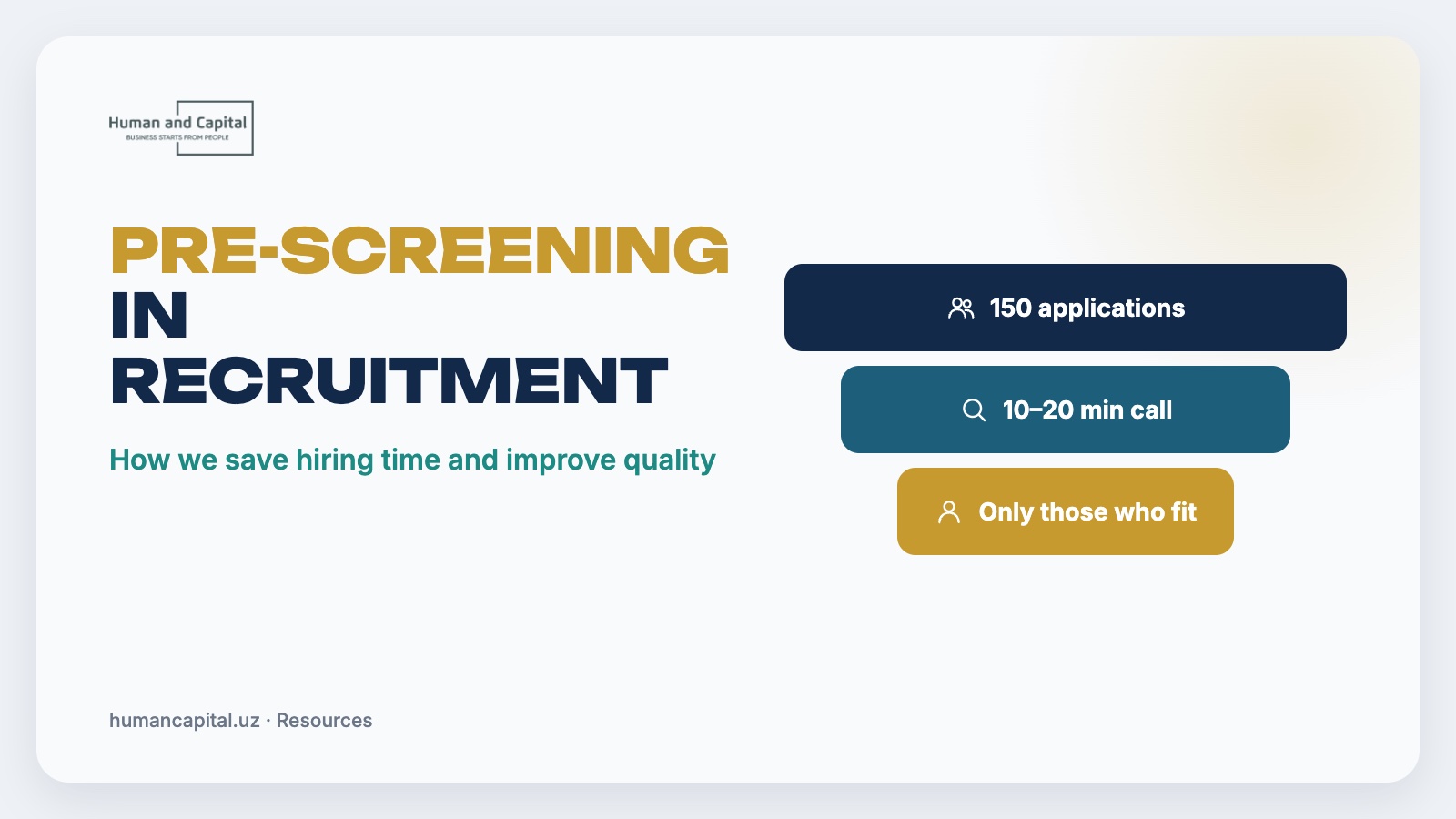
Imagine a vacancy receives 150 applications. Even if reviewing each CV takes just 3 minutes, the recruiter needs more than 7 hours for the initial review alone. Then they must contact the candidates, run phone interviews and only after that present the most suitable specialists to the manager.
That is why pre-screening is one of the key stages of modern recruitment.
What is pre-screening?
Pre-screening is the initial assessment of a candidate before the main interview.
Its goal is to quickly determine whether the candidate meets the basic requirements of the vacancy and whether to move on to the next stage.
It is important to understand that pre-screening is not a full interview. It is a short check that saves time for both the company and the candidate.
What does pre-screening achieve?
The main goal is not to find the perfect candidate but to rule out obvious mismatches.
During pre-screening the recruiter usually checks:
- whether the candidate is actively looking for a job;
- their interest in the vacancy;
- experience in the required field;
- key professional skills;
- foreign language level (if it matters for the role);
- salary expectations;
- readiness for the proposed schedule;
- readiness for business trips or relocation;
- when they can start.
After such a conversation it becomes clear whether to invite the candidate to a full interview.
Why you should not skip this stage
Sometimes companies try to speed up hiring and go straight to an interview with the manager.
At first glance this looks efficient.
But in practice the manager may spend several hours meeting candidates who:
- expect a salary well above the budget;
- are not ready to work in the office;
- see the offer only as a backup option;
- lack the required competencies;
- cannot start on the required date.
As a result, everyone involved loses time.
Pre-screening helps avoid such situations.
What does an experienced recruiter assess?
Beyond the formal criteria, the first conversation can provide valuable information about the candidate.
For example:
- how interested the person is in the vacancy;
- how they talk about their experience;
- how coherently they express their thoughts;
- what motivates them to consider a change of job;
- what they expect from a new employer;
- how realistic their career plans are.
These details help prepare for the main interview and make it more meaningful.
How long should pre-screening take?
A common mistake is to turn pre-screening into a full one-hour interview.
The optimal length is 10–20 minutes.
That is enough to:
- check the main requirements;
- answer the candidate's questions;
- understand the level of mutual interest;
- decide on the next step.
If the conversation stretches to 40–60 minutes, you are already conducting an interview, not a pre-screening.
How pre-screening helps the business
Well-organised pre-screening helps to:
- reduce the number of irrelevant interviews;
- lighten the load on managers;
- speed up the hiring process;
- fill vacancies faster;
- improve the quality of the candidates presented;
- increase the chance that an offer is accepted.
The effect is especially noticeable in mass recruitment or when hiring for scarce skills, where the speed of decisions is decisive.
How we run pre-screening at Human and Capital
For us pre-screening is not a formal CV check.
Before presenting a candidate to a client, we try to understand not only their professional experience but also their motivation, career expectations and readiness for the proposed conditions.
We always discuss:
- why the candidate is considering a change of job;
- which projects interest them;
- which conditions are non-negotiable for them;
- whether the vacancy matches their professional expectations;
- whether they are ready to go through all stages of selection.
This approach lets us send the client not just profiles that match on paper, but candidates who are genuinely interested in the vacancy and ready to move forward.
Pre-screening is respect for time
Good recruitment is not about the number of interviews held, but about the quality of the decisions made.
Every unnecessary stage, every meeting without a result is lost time for the company, the manager and the candidate.
That is why pre-screening should not be seen as extra bureaucracy. It is a tool that makes hiring faster, more transparent and more effective.
In conclusion
With high competition for specialists, hiring speed becomes one of an employer's key advantages. But speed should not come at the expense of quality.
Pre-screening is what strikes the balance between the two. It helps quickly filter out unsuitable candidates, focus on genuinely promising specialists and make the selection process more comfortable for everyone.
Good pre-screening is more than a first call to a candidate. It is the foundation of quality recruitment and one of the most effective ways to save time in hiring.
Learn more about our recruitment service.