A competency-based interview (CBI) is one of the most effective and structured methods of assessing candidates, widely used in modern recruitment.
Put simply, it is an interview that assesses not what a person says about themselves, but how they actually acted in specific work situations in the past.
What are competencies?
Competencies are more than knowledge or experience.
They are a combination of:
- skills;
- patterns of behaviour;
- ways of making decisions;
- personal qualities that affect work results.
For example:
- responsibility;
- leadership;
- analytical thinking;
- communication;
- stress resilience;
- results orientation.
What is the core idea of a competency-based interview?
The main principle is very simple:
past behaviour = the best predictor of future behaviour
Instead of questions like:
- “What can you do?”
- “What skills do you have?”
the interviewer asks:
- “Tell me about a situation when…”
- “Give an example of how you…”
- “What did you do when…”
Sample questions
1. Responsibility
- Tell me about a time you made a mistake. What did you do?
2. Teamwork
- Give an example of a conflict in your team and how you resolved it.
3. Stress resilience
- Tell me about your most difficult project and how you coped with deadline pressure.
4. Decision-making
- Describe a situation when you had several ways to solve a problem. How did you choose?
Why does this method work better than a regular interview?
A regular interview often looks like this:
- the candidate describes how things should be;
- the recruiter gets ideal but abstract answers.
A competency-based interview lets you:
- move from theory to real cases;
- see real experience rather than declared skills;
- assess the candidate's reasoning;
- understand how they behave under stress.
How is a competency-based interview conducted?
The process usually looks like this:
1. Key competencies are defined
For example:
- communication;
- leadership;
- analytical skills;
- teamwork.
2. Questions are prepared for each competency
3. A single interview structure is used
All candidates get the same questions.
4. The assessment is recorded on a scale
For example:
- 1 – weak;
- 3 – average;
- 5 – strong.
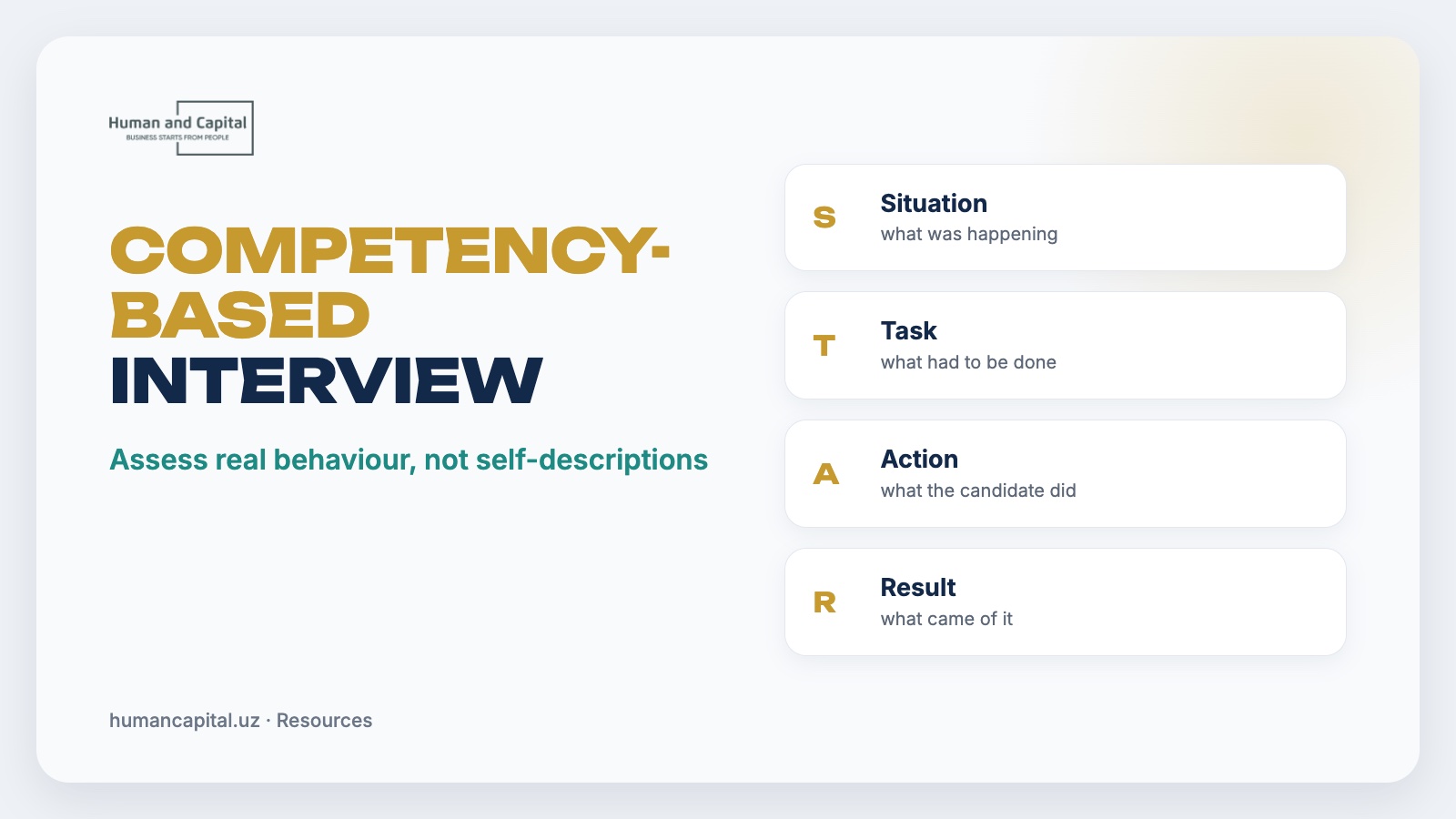
The STAR method – the basis of the interview
Candidates' answers are most often analysed using the STAR model:
- S (Situation)
- T (Task)
- A (Action)
- R (Result)
If a candidate describes only the situation without the result, the answer is considered incomplete.
Common candidate mistakes
In this kind of interview candidates often:
- speak in general phrases (“we worked as a team”);
- give no specific examples;
- confuse their own actions with the team's;
- cannot describe the result;
- drift into theory instead of practice.
Common recruiter mistakes
The method loses its effectiveness if:
- general questions are asked without structure;
- answers are not recorded;
- the interview turns into an ordinary conversation;
- no rating scale is used;
- candidates are not asked the same questions.
Where are competency-based interviews used?
The method is especially effective for:
- IT and digital roles;
- management roles;
- sales;
- HR and administrative functions;
- international companies;
- mass and mid-level recruitment.
Pros of the method
- high objectivity;
- less influence of subjective opinion;
- candidates can be compared;
- it predicts behaviour at work;
- a structured assessment process.
Cons of the method
- it requires preparation;
- it takes longer than a regular interview;
- it does not always suit entry-level roles;
- recruiters need training.
In conclusion
A competency-based interview is a move from intuitive hiring to a systematic assessment of candidates.
Its main value is that it shows not how a person describes themselves, but how they actually act in work situations.
In modern recruitment this approach is becoming the standard for quality hiring, especially where a wrong hire is expensive.
In short: competencies are not words but behaviour. And a competency-based interview is a way to see that behaviour.
Every candidate we present goes through a competency-based assessment. Learn more about our recruitment service.